


Can Dubai Building Management Fine Owners for Children in Common Areas? 2026 Legal Guide
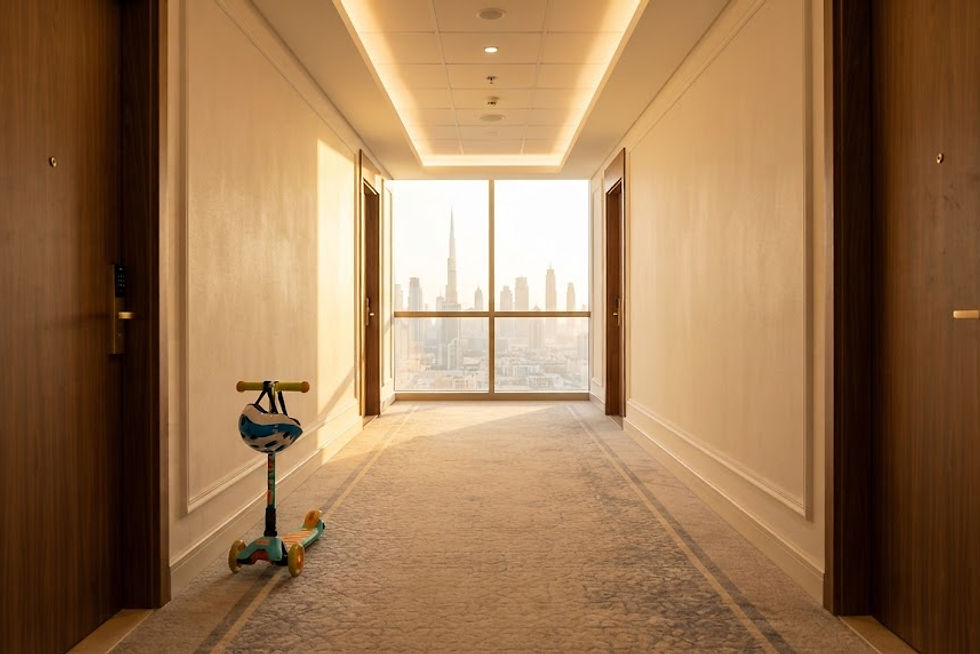
I stepped into the elevator of my Downtown Dubai tower last Tuesday afternoon just as a mother was pulling down a brightly printed warning notice taped next to the call button. The notice threatened an immediate financial penalty of AED 500 on any apartment resident whose children rode kick-scooters or played in the carpeted residential hallways.
Watching her frustrated expression reminded me how frequently this friction surfaces across residential communities in Dubai every autumn. As families balance cramped apartment layouts with energetic toddlers, building management companies and owners association boards increasingly push back with stern emails, security logs, and threats of administrative fines.
At a glance | Details |
|---|---|
Governing law | Dubai Law No. 6 of 2019 |
Supervising authority | RERA and Dubai Land Department |
Direct fine power | Requires explicit RERA judicial approval |
Standard cure notice | 24 to 48 hours written warning |
Dispute venue | Rental Disputes Center at DLD |
The Legal Reality of Building Management Fines in Dubai

A recent legal analysis reported by Khaleej Times highlights that private management companies cannot unilaterally invent arbitrary financial penalties against apartment residents. Under the legal framework governing Dubai real estate, a facility management company or a developer does not possess standalone judicial authority to levy penal fines on tenants or homeowners without formal regulatory sanction.
Regulatory announcements published by the Emirates News Agency document how property regulatory reforms protect residents from unauthorized community service surcharges. The Real Estate Regulatory Agency, known across the emirate as RERA, maintains strict oversight over jointly owned property declarations and administrative bylaws. While property management companies can issue formal breach notices and demand compliance with safety rules, transforming an alleged nuisance into a payable cash invoice requires statutory adherence to registered community declarations.
The Role of RERA in Community Penalties
The Real Estate Regulatory Agency requires that all community rules and potential financial sanctions be formally registered through the Mollak electronic system. If a building rule is not approved within the registered building management charter, management staff cannot append financial surcharges to your utility billing account or service charge statement.
Difference Between Landlords and Tenants Under Building Rules
Building management interacts primarily with the registered unit title deed holder rather than the tenant directly. When a management company issues a penalty notice for corridor use, they typically dispatch the claim to the property landlord, who may then attempt to pass the liability onto the occupying tenant under standard lease default terms.
Private management operators often print menacing warnings on building noticeboards, but an informal invoice has zero legal weight without registered regulatory backing.
Jointly Owned Property Law and Common Area Definitions
Official legal procedures outlined on the UAE Government Portal confirm that statutory property management powers derive from formal legislation rather than unapproved notices. Dubai Law No. 6 of 2019 Concerning Ownership of Jointly Owned Real Property established clear boundaries for how common areas must be managed, maintained, and enjoyed by all title deed holders and registered occupants.
Common areas comprise all segments of a building outside individual private boundaries, including elevator lobbies, shared corridors, emergency stairwells, shared swimming pools, and dedicated landscaped play yards. The law dictates that common areas exist for the collective benefit of all co-owners, meaning no single occupant may obstruct passageways or create persistent safety hazards that infringe upon neighboring residents.
Residential corridors serve strictly as transit passages and must remain clear of personal storage or hazards.
Emergency fire escape routes are legally protected corridors subject to strict municipal safety codes.
Designated outdoor courtyards and podium gardens permit recreational movement subject to posted community hours.
Hallways Versus Play Areas: Permitted Activities Compared
Public safety guidelines maintained by Dubai Police emphasize that residential hallways must remain clear of scooters and toys to preserve fire escape routes. Leaving scooters, bicycles, and toy prams in carpeted corridors poses an immediate evacuation risk during building fire alarms and creates noise disturbances that echo directly into adjacent apartment living rooms.
Building utility safety protocols from DEWA mandate that electrical service risers and corridor panels remain completely unobstructed by personal belongings. In contrast, outdoor podium decks, community lawn spaces, and dedicated indoor children playrooms exist precisely to accommodate active recreation, provided children observe basic safety and volume standards.
Location | Permitted Use | Operational Rules |
|---|---|---|
Corridors | Transit only | No unattended play |
Courtyards | Supervised recreation | Observe quiet hours |
Playgrounds | Full active play | Adhere to posted times |
How Financial Penalties Are Actually Enforced and Contested
When a property management company sends an invoice for corridor noise or children playing, many residents panic and pay immediately out of fear that their building access access cards will be deactivated. However, blocking access cards or withholding community entry over an unadjudicated penalty constitutes an unlawful restriction of tenancy rights under Dubai tenancy law.
Pedestrian safety standards referenced by RTA Dubai illustrate why residential driveway speeds and loading zones require supervised child movement. If a building manager asserts that unattended play generated safety risks near vehicle ramps, they must document the incident with time-stamped security logs before demanding administrative remedies through formal channels.
The Burden of Proof on Management
Building security teams cannot levy claims based merely on unsubstantiated neighbor complaints. Management must produce specific CCTV footage, formal security patrol logs, or photographic evidence documenting that a specific unit resident caused intentional property damage or repeatedly blocked fire exit corridors.
Role of the Rental Disputes Center
If a landlord attempts to deduct an unapproved building management fine from a security deposit, the tenant has the legal right to file a dispute petition at the Rental Disputes Center located at the Dubai Land Department headquarters in Deira.
Building managers cannot deactivate your entry cards or cut off parking gate access over an unpaid, contested corridor fine.
Step-by-Step Response When You Receive an Unofficial Fine Notice
Receiving an aggressive letter from your building facility office can feel intimidating, but reacting constructively protects your tenancy record while preserving community relationships. Follow an orderly sequence of actions to verify the validity of the notice before consenting to any financial deduction or admitting default.
Review your registered tenancy contract and building community rules document to see if specific financial penalty schedules were officially appended.
Request the building manager to provide written verification that the penalty schedule was formally registered and approved through the RERA Mollak system.
Ask for concrete time-stamped evidence or security patrol incident reports identifying the alleged disturbance.
Notify your landlord in writing that the penalty is contested and request their formal support in mediating with the owners association board.
File an informational inquiry or formal complaint with the Rental Disputes Center if building security threatens access card deactivation.
Practical Community Etiquette and Escalation Options for Families
Living in high-density residential towers in areas like Dubai Marina, Jumeirah Village Circle, or Downtown requires reciprocal consideration between young families and working professionals. While corridors should never become improvised football pitches or scooter racetracks, building management must also demonstrate reasonable proportionality when toddlers momentarily step into elevator vestibules.
Families who find indoor apartment space restrictive can make active use of community podium parks, shaded garden tracks, or neighborhood recreational centers. Maintaining an open communication channel with immediate corridor neighbors prevents minor acoustic friction from escalating into formal security incidents.
Establish clear household boundaries ensuring shoes, bicycles, and scooters remain parked inside your private entryway.
Schedule active sports and scooter riding for dedicated community outdoor tracks and parks rather than tiled hallways.
Introduce yourself to immediate floor neighbors so they feel comfortable approaching you directly before filing security reports.
A polite ten-minute chat with your corridor neighbors solves noise misunderstandings far faster than trading hostile emails with building security.
FAQ
Can a Dubai building manager deactivate my access cards for an unpaid fine?
No, facility managers cannot unilaterally disconnect access cards, deactivate parking remotes, or bar entry to your leased unit over contested fines. Such actions violate Dubai tenancy regulations and can be reported directly to RERA or the police as unlawful eviction attempts.
Can my landlord deduct building management fines from my security deposit?
A landlord cannot deduct building management fines from your rental security deposit unless the penalty was officially confirmed through the Rental Disputes Center or explicitly stipulated in a signed tenancy addendum. You can petition the RDC to recover unauthorized deductions upon lease termination.
What is the official procedure for building management to issue valid fines?
Building management must first issue a formal written warning specifying the violation and providing a cure period of at least 24 to 48 hours. If non-compliance continues, any financial penalty must match pre-approved RERA community declarations filed through the Mollak system.
Are children legally barred from playing in building courtyards?
Children are not barred from outdoor courtyards or communal gardens unless specific building declarations restrict active play to preserve safety. However, children must respect posted quiet hours, usually beginning at 10 PM, and remain supervised by parents.
Useful Links
Khaleej Times — legal advisory on common area fines
Emirates News Agency — official real estate regulatory updates archive
UAE Government Portal — official jointly owned property regulations guide
Dubai Police — official public safety and hazard reporting
DEWA — utility safety and building code compliance
RTA Dubai — guidance on residential parking and access
Pair It With

— Angel Tyagi, Creator of Angel In Dubai
Prices, timings and availability may change — always check directly with the venue before visiting. Not sponsored.
Story lead: khaleejtimes.com. Reporting can be updated or withdrawn after publication — always check the original before relying on anything here.
Rates and figures are indicative and were correct as of 11 October 2026; they change often, so verify with the provider before acting. This is general information, not financial advice.
Rules, fees and deadlines change often. This is a general summary, not legal advice — confirm with the relevant UAE authority before acting.
Photo by Dubai Travel in Style and Luxury - A Must-Experience! via web, Photo by Dubai Travel in Style and Luxury - A Must-Experience! via web, Photo by AI-generated illustration via gemini


Comments