


DP World GCC Inland Freight Expansion: Rail & Road Logistics Guide (2026)
- 21 hours ago
- 6 min read
Standing near the Jebel Ali Free Zone logistics corridor, watching heavy freight trains pull long lines of intermodal containers straight out toward desert rail tracks, you realize how dramatically GCC trade routes have shifted. What used to rely primarily on sea feeder shipping around the Arabian Peninsula is now moving swiftly overland.
DP World has officially crossed the milestone of moving 500,000 TEU containers across GCC inland rail and road freight networks (as of August 2026, source: DP World Operational Milestone Announcement). As someone who closely tracks commercial logistics and regional economic infrastructure, I broke down what this expansion means for regional trade velocity, shipping costs, and supply chain efficiency. *Disclaimer: This analysis is for informational and educational purposes only and does not constitute financial, investment, or commercial advice.*
1. The 500,000 TEU Milestone: Breaking Down DP World's Land Freight Growth
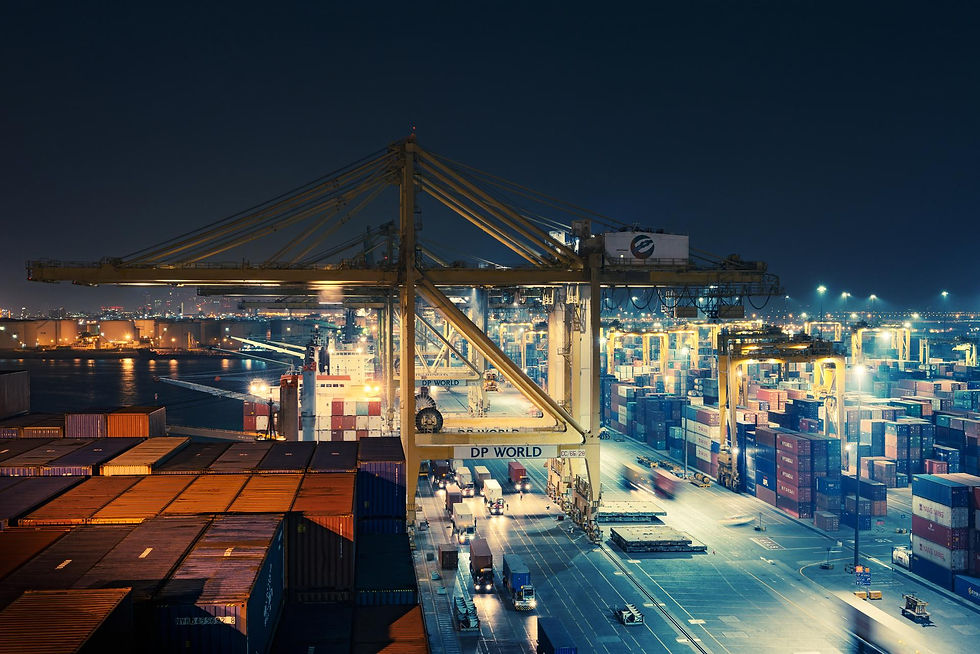
DP World’s inland freight operations have experienced accelerated growth over recent quarters, driven by heavy investment in multimodal logistics hubs and strategic integration with regional rail infrastructure. Moving 500,000 TEU containers via land rail and road networks marks a structural shift in Middle East supply chains (as of August 2026, source: DP World Logistics Division Report).
By connecting sea ports directly to inland dry ports in Saudi Arabia and the broader Gulf, DP World is reducing reliance on traditional coastal feeder vessels. Freight that previously spent days idling in congestion or navigating maritime chokepoints can now clear customs digitally and board scheduled freight trains.
Intermodal Connectivity from Jebel Ali to GCC Capitals
The core driver behind this volume spike is seamless intermodal transfers at Jebel Ali Port. Containers offloaded from ocean megaships are transferred directly to rail wagons or long-haul truck fleets without leaving bonded customs zones, shaving days off total transit times.
Shift from Sea Feeders to Land Corridors
Historically, shipping goods from Dubai to inland destinations like Riyadh required sea feeder transit to Dammam port followed by local drayage. Land freight corridors bypass maritime detours entirely, offering a direct terrestrial pipeline.
Milestone Reached: 500,000 TEU containers moved via GCC land freight (as of August 2026, source: DP World Official Announcement).
Primary Rail Backbone: Etihad Rail freight corridors connecting Dubai and Abu Dhabi ports to Saudi border terminals.
Overland Coverage: Integrated road and rail routes spanning the UAE, Saudi Arabia, Oman, and Qatar.
Target Growth: Inland freight volumes projected to expand further as secondary rail spurs come online.
Seeing freight move from Jebel Ali Port directly onto rail tracks cutting through the desert shows how quickly the GCC is building an integrated inland trade backbone.
2. Cost & Speed Comparison: Rail Freight vs Road vs Sea Feeders in the GCC
Evaluating transportation modes across the Gulf requires balancing speed, cost predictability, and carbon footprint. The table below outlines key benchmarks for cargo moving between Dubai and regional destinations.
Transport Mode | Avg Transit Time (Dubai to Riyadh) | Cost Efficiency & Sustainability | Source & Benchmark Note |
|---|---|---|---|
Intermodal Rail Freight | 24 – 36 hours (as of August 2026) | Up to 30% carbon emission reduction vs heavy trucking | DP World & Etihad Rail Operational Benchmarks (indicative — verify with operator) |
Long-Haul Road Trucking | 36 – 48 hours (as of August 2026) | High door-to-door flexibility, subject to fuel price shifts | GCC Freight Haulage Survey (indicative — verify with carrier) |
Coastal Sea Feeder | 4 – 6 days (as of August 2026) | Lowest upfront cost for non-urgent bulk cargo | Regional Maritime Shipping Schedules (indicative — verify with line) |
3. Infrastructure Drivers: Etihad Rail and GCC Railway Integration
The rapid scaling of DP World’s land freight network is tightly coupled with the rollout of the UAE’s Etihad Rail network and cross-border customs modernization.
Etihad Rail Freight Terminals in Abu Dhabi and Dubai
With high-capacity freight terminals situated in key industrial zones, manufacturing and distribution businesses can bypass urban traffic congestion entirely. Heavy goods load directly onto 2-kilometer-long freight trains capable of hauling hundreds of containers per voyage.
Cross-Border Customs Integration and E-Customs Clearance
Digital customs integration between GCC member states has dramatically simplified border crossings. Automated pre-clearance and smart seals allow freight trains to pass international borders with minimal stopover time.
Etihad Rail Freight Terminals: Operational dry ports at ICAD (Abu Dhabi), Industrial City Dubai, and Fujairah.
Bonded Land Corridors: Sealed containers move under single custom declarations across UAE-Saudi border posts.
Streamlined digital customs at GCC land borders have eliminated days of paperwork delays for cross-border logistics operators.
4. Business & Supply Chain Impact for UAE Enterprises

For businesses operating out of Dubai free zones and Abu Dhabi industrial parks, land freight expansion changes fundamental inventory management strategies.
Inventory Velocity and Warehouse Footprint Optimization
Faster land transit times allow regional distributors to maintain leaner safety stocks. Rather than stocking redundant inventory in multiple GCC warehouses, companies can centralize storage in Dubai or Abu Dhabi dry ports and fulfill regional orders within 24 to 48 hours.
E-Commerce and FMCG Fast-Track Distribution
Fast-moving consumer goods (FMCG) and retail e-commerce platforms benefit significantly from predictable rail and road schedules, reducing stockout risks during peak promotional seasons across Saudi Arabia and the UAE.
5. Sustainability and Carbon Reduction in GCC Freight Logistics
Decarbonizing supply chains is a top priority for corporate operations across the Middle East, aligned with national net-zero targets.
Decarbonizing Heavy Transport Across the Arabian Peninsula
Rail freight generates up to 75% fewer greenhouse gas emissions per ton-kilometer compared to heavy diesel trucking. Replacing thousands of truck journeys across desert highways with electrified or fuel-efficient locomotives yields immediate environmental benefits.
Corporate ESG Compliance and Scope 3 Emissions
Multinational companies reporting Scope 3 supply chain emissions can document tangible carbon reductions by routing inland GCC cargo via DP World’s rail-connected logistics networks (as of August 2026, source: UAE Ministry of Climate Change Data).
For multinational firms operating out of Dubai free zones, switching to rail-backed logistics is now the fastest route to meeting ESG carbon reduction targets.
6. Practical Business Guide: How Companies Can Leverage GCC Land Freight
Businesses looking to optimize regional trade routes should take a systematic approach to evaluating inland freight options.
Audit current regional shipping transit times against rail and intermodal options (as of August 2026, source: DP World Supply Chain Guide).
Utilize bonded land rail corridors to defer customs duties until goods arrive at their final destination dry port.
Integrate digital freight tracking APIs via DP World's CARGOES software platform for end-to-end container visibility.
Verify exact freight rates and schedule commitments directly with freight forwarders as pricing remains indicative — verify with operator.
FAQ
What is the DP World GCC inland freight expansion?
It is DP World's integrated logistics initiative connecting UAE ports like Jebel Ali directly to GCC hinterlands via Etihad Rail and cross-border road freight networks, recently reaching 500,000 containers moved (as of August 2026, source: DP World Official Milestone Announcement).
How much faster is GCC rail freight compared to sea feeder shipping?
Rail freight between Dubai and inland destinations like Riyadh typically takes 24 to 36 hours, compared to 4 to 6 days for coastal sea feeder vessels (as of August 2026, source: DP World Logistics Data; indicative — verify with operator).
Which GCC countries are linked by DP World's land freight network?
The network connects the UAE with Saudi Arabia, Oman, Qatar, and broader GCC land routes via integrated rail terminals and highway corridors.
Are freight rates fixed or subject to change?
Freight rates vary based on container volume, cargo type, season, and fuel surcharges. All cited rates and figures are indicative — verify with operator before booking.
Useful Links
Dubai Chamber of Commerce · Ministry of Economy · UAE Government Portal · DIFC · Etihad Rail · DP World
Pair It With
Dubai Free Zone Commercial Occupancy Office Space 2026 · Uae E Invoicing System Compliance Guide 2026 1

— Angel Tyagi, Creator of Angel In Dubai
Prices, timings and availability may change — always check directly with the venue before visiting. Not sponsored.
Rates and figures are indicative and were correct as of 21 August 2026; they change often, so verify with the provider before acting. This is general information, not financial advice.
Photo by DP World And Einride Expand Electric Freight Operations At Jebel Ali ... via web, Photo by DP World UAE via web, Photo by Jafza Logistics Parks | Jebel Ali Free Zone (Jafza) via web


Comments