


Setting Up a Business in Dubai in 2026: The Honest Guide to Routes, Tax & Real Costs
- Jun 19
- 6 min read
The first time someone asks you, over a flat white in a Dubai Design District café, "so are you going mainland or free zone?", it can feel like you've walked into the middle of a conversation everyone else started years ago. I have watched that exact flicker of panic cross more friends' faces than I can count — talented people with a real idea, suddenly drowning in acronyms, agents and WhatsApp groups promising a licence by Thursday.
Here is the calm version. Dubai in 2026 is still one of the most genuinely open places on earth to start something — 100% foreign ownership on the mainland, no personal income tax, and a setup that can be done in days rather than months. What has changed is that it is no longer entirely tax-free, and the details now actually matter. So let me walk you through the routes, the real costs, and the numbers nobody texts you about before you sign.
Mainland or free zone: the one decision everything hangs on
Almost every other choice flows from this one. A mainland company is licensed by the Dubai Department of Economy and Tourism (DET) and can trade directly with the local UAE market, take government contracts, and open a shop or office anywhere in the emirate. Since the 2021 reform, most activities allow 100% foreign ownership — the old "you need a 51% Emirati partner" rule is gone for the vast majority of commercial and professional licences.
A free zone company is licensed inside one of Dubai's 40-plus free zones — think DMCC in Jumeirah Lakes Towers, the financial hub DIFC, or budget-friendly options like IFZA and Meydan Free Zone. Free zones give you 100% ownership, easy visa quotas and fast set-up, but to sell directly into the mainland UAE market you usually need a local distributor or a dual licence. As of June 2026, DMCC alone hosts more than 25,000 member companies — these are real ecosystems, not just a PO box.
Is Dubai still tax-free? The honest 2026 answer
Not quite — and anyone who tells you otherwise is selling something. Here is the real picture, as of June 2026, and you should still verify the live thresholds with the Federal Tax Authority before you act on any number:
Personal income tax — Still zero. Salaries, dividends to individuals and personal capital gains are not taxed in the UAE (source: Federal Tax Authority, as of June 2026).
Corporate tax — 0% then 9% — Companies pay 0% on the first AED 375,000 of taxable profit and 9% on profit above that. So a business clearing AED 300,000 profit a year still pays nothing (source: Federal Tax Authority / ClearTax, as of June 2026).
Small Business Relief — If your revenue is under AED 3 million, you can elect relief that effectively treats you as having no taxable income — available for tax periods ending on or before 31 December 2026 (source: Federal Tax Authority, as of June 2026; indicative — confirm your eligibility before relying on it).
VAT — 5% — The standard rate is 5%. Registration is mandatory once your taxable turnover passes AED 375,000 in any 12-month window, and voluntary from AED 187,500 (source: Federal Tax Authority, as of June 2026).
Free-zone 0% — A Qualifying Free Zone Person can still pay 0% corporate tax on qualifying income — but only if it meets genuine substance and qualifying-activity rules; non-qualifying income is taxed at 9% (source: Federal Tax Authority, as of June 2026).
The practical headline: most small founders will still pay little or no corporate tax in their first couple of years, but you now have to register, keep proper books and file. Corporate tax returns are generally due within nine months of your tax period ending. These figures are indicative and change — always reconcile against the FTA's own current guidance.

What it actually costs to start
Here is where the glossy brochures and reality part ways. The cheapest advertised free-zone licence in Dubai sits around AED 12,500 (Meydan Free Zone and IFZA both market entry packages near this level, as of June 2026). But a licence on its own is not a working business. Once you add registration, a flexi-desk address and a single investor visa, a realistic first-year all-in total usually lands between AED 18,000 and AED 25,000 (source: Middle East Briefing's 2026 Dubai setup guide; indicative — every zone prices visas, medicals and Emirates ID separately, so confirm the full quote in writing before you pay).
A mainland professional licence can start a touch lower — roughly AED 10,000 to AED 14,000 for the licence itself — but you then layer on the DET fees, immigration card and office or Ejari-registered address, plus any third-party approvals your activity needs. Whatever you are quoted, ask for the line items: government fee, name reservation, initial approval, licence, establishment card, visa allocation. The gap between the headline price and the all-in number is where the surprises live.
My one rule, learned the expensive way: never pay a setup agent a single dirham until they have sent you an itemised quote and the name of the exact free zone or DET activity code you are registering. "Trust me, it's all included" is not a number.

The setup, step by step
Stripped of the jargon, almost every Dubai setup follows the same spine, whether you go mainland or free zone:
1. Pick your activity and route — Choose your business activity code and decide mainland (DET) or a specific free zone. This drives everything — ownership, where you can sell, and your visa quota.
2. Reserve your trade name and get initial approval — A quick check that your name and activity are permitted. Avoid anything implying religious or governmental ties.
3. Sort your address — A flexi-desk or co-working spot in a free zone, or an Ejari-registered office on the mainland. Your visa quota is tied to your space.
4. Get the licence issued — Pay the government and licence fees and receive your commercial or professional licence — often within 5–10 days in a free zone, a little longer on the mainland.
5. Establishment card, visas and bank account — Open your immigration file, process investor and staff visas (entry permit → medical → Emirates ID → stamping), then open a corporate bank account — usually the slowest step, so start gathering documents early.
6. Register for tax — Register for corporate tax, and for VAT if you will cross the threshold. Keep clean books from day one — it is far cheaper than fixing them later.
Who each route really suits
If you are a consultant, freelancer or digital business selling mostly to clients abroad or to other companies, a lean free-zone licence is often the sweet spot — low cost, fast, 100% yours. If you want a shop, a restaurant, a clinic or anything selling directly to UAE consumers and government, mainland is usually the cleaner long-term path. And if you are building something venture-scale — Dubai minted home-grown success stories like the beauty-tech unicorn Fresha — the financial free zones and their investor networks start to matter more than the licence fee. There is no universally "best" route; there is only the one that fits what you are actually building.
Two more threads worth pulling before you commit: the new UAE Civil Transactions Law changes that took effect in 2026 (they touch contracts and liability you will sign as a business owner), and the residency angle — many founders pair a company with a long-term visa, and the rules around Dubai's property investor visa and golden visas have shifted recently. If you are still weighing whether to move at all, my guide to finding a job in Dubai as an expat is a gentler first step than registering a company.
A note on the numbers: every figure here is dated to June 2026 and drawn from the Federal Tax Authority, Dubai's Department of Economy and Tourism, and Middle East Briefing's 2026 guide. Tax thresholds, licence prices and free-zone packages change frequently and vary by activity — these are indicative, not a quote. This article is general information, not financial, tax or legal advice; speak to a licensed setup consultant, a tax adviser and the FTA for your specific situation before you commit any money. This is not financial advice. Not sponsored.
Sources & official desks: Federal Tax Authority · Invest in Dubai — business setup · Dubai DET · Corporate-tax explainer (ClearTax) · DET on Google Maps.
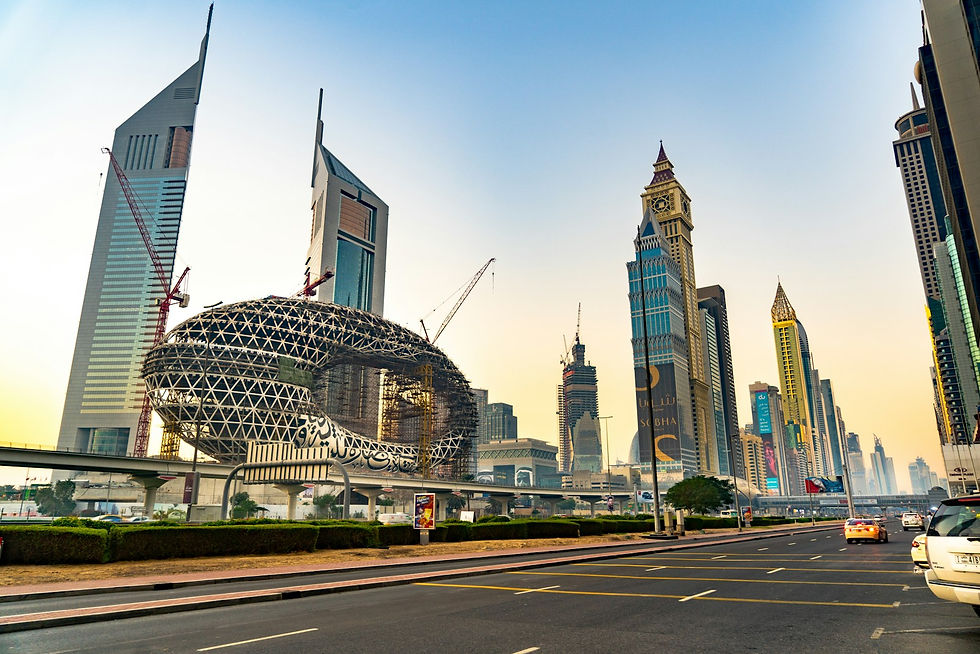
Photos: Emirates Towers and Crowne Plaza, Sheikh Zayed Road with the Museum of the Future, and the Downtown Dubai skyline — all genuine Dubai scenes via Unsplash. The meeting-room image is a representative business photo, not a specific Dubai office. All were reviewed this session for subject, location and quality. Photo by the respective Unsplash contributors — see each image's Unsplash page for the photographer's name.
— Angel Tyagi, Creator of Angel In Dubai


Comments