


How to Buy US Stocks in the UAE: 2026 Broker Comparison and Tax Guide
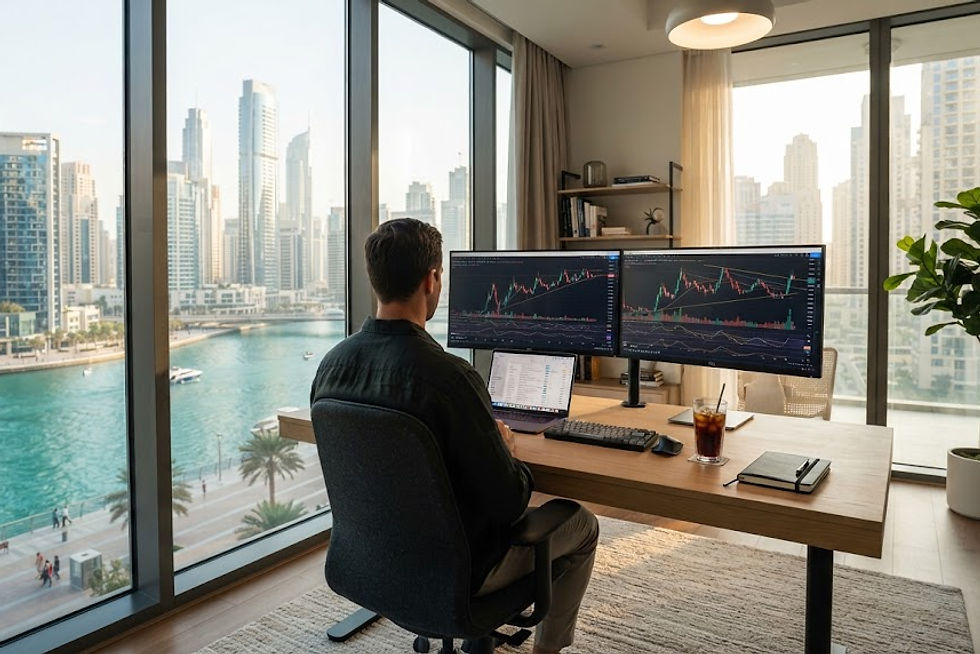
Sitting at my desk in Business Bay with an iced Americano, I watched the New York market open across two split monitors while reviewing my quarterly portfolio statement. Like thousands of UAE expatriates who earn in dirhams, my biggest financial question each month is how to channel savings into diversified global equities without losing money to hidden currency spreads and opaque platform fees.
Building an international stock portfolio from Dubai has never been simpler, but selecting the right platform requires balancing regulatory safety, commission costs, and international dividend taxation. As of October 2026, retail investors in the Emirates can choose between established global brokerage powerhouses and fast-growing regional fintech platforms, each with distinct trade-offs.
At a glance | Details |
|---|---|
Top platforms | Interactive Brokers, Saxo, Sarwa |
Min deposit | AED 0 to AED 7,350 as of 2026 |
US dividend tax | 30 percent withholding at source |
Funding methods | Local AED transfer or USD wire |
Approval time | 24 to 72 hours as of 2026 |
Key regulators | SCA, DFSA, FSRA, US SEC |
Top International Brokers for UAE Residents Compared

Choosing an international brokerage as a UAE expat involves weighing deposit thresholds, transaction costs, and asset availability. My ranking of these platforms is an editorial opinion based on account evaluations and fee schedules as of October 2026. Note that this guide is for educational purposes only and is not financial advice. All fees and deposit figures cited are indicative — verify with the broker before depositing capital. Source: published broker tariff schedules as of October 2026.
Interactive Brokers for Active and Global Investors
Interactive Brokers is a benchmark for direct access to over 150 global markets with competitive exchange spreads. As of October 2026, the platform charges zero minimum deposit on cash accounts and USD 0.005 per share on fixed US stock pricing, with a USD 1.00 minimum per order. Source: Interactive Brokers fee schedule as of October 2026; trading fees are indicative — verify with the broker.
Saxo Bank and Sarwa for Turnkey Portfolios
Saxo Bank provides a banking-grade interface and holds a Category 4 license from the DFSA in the Dubai International Financial Centre. Its classic tier requires an entry deposit of USD 2,000, roughly AED 7,350 as of October 2026, with US equity trades starting at USD 0.03 per share with a USD 3 minimum charge. Source: Saxo Bank UAE schedule as of October 2026; rates are indicative — verify with the broker. Meanwhile, Dubai-based Sarwa offers zero-commission trading on US stocks through Sarwa Trade with no account minimums, appealing to beginner mobile-first investors.
Broker | Min Deposit | Trade Fee |
|---|---|---|
Interactive Brokers | Zero as of October 2026 | USD 0.005 per share |
Saxo Bank | AED 7,350 as of 2026 | USD 0.03 per share |
Sarwa Trade | Zero as of October 2026 | Zero on US stocks |
I keep my core international holdings on an institutional platform to minimize recurring custodian overhead while managing cash flows in dirhams.
UAE Regulatory Oversight and Investor Protections
Before opening any account, I always verify whether an entity holds onshore authorization from the Securities & Commodities Authority or operates under free-zone regimes like the DIFC or ADGM. Regulatory licensing determines client fund segregation, dispute resolution mechanisms, and bankruptcy protection.
Onshore SCA Licensing versus Financial Free Zones
Brokers operating in mainland UAE hold licensing from the Securities & Commodities Authority, which enforces capital adequacy rules and investor protection standards as of October 2026. Free zones operate independent common-law jurisdictions: the Dubai Financial Services Authority governs firms in DIFC, while the Financial Services Regulatory Authority oversees ADGM entities. Both authorities mandate segregated accounts for client funds so customer assets remain protected from operational liabilities.
Foreign Account Protections and SIPC Insurance
For accounts held directly with US brokerage subsidiaries, protection falls under the Securities Investor Protection Corporation. As of October 2026, SIPC protects securities and cash up to USD 500,000, including a USD 250,000 cash limit, in the event of broker insolvency. Source: SIPC member rules as of October 2026; coverage is indicative — verify with the broker. Note that statutory protection guards against institutional failure, never against normal market losses.
US Dividend Withholding Tax and Estate Tax Rules
Tax efficiency is often the most overlooked component of overseas equity investing for UAE residents. Because the UAE levies no personal income tax, many expats assume foreign dividends arrive completely tax-free. However, the United States taxes dividends distributed by US corporations at source, regardless of investor residence.
The 30 Percent US Dividend Withholding Tax
When completing foreign tax documentation, the Federal Tax Authority provides guidelines clarifying that individual salary earners in the Emirates face no domestic taxes on overseas equity growth. However, because the UAE and the United States do not share a double taxation avoidance treaty for equity dividends as of October 2026, UAE residents face a statutory 30 percent withholding tax on all dividends paid by US companies. Source: IRS statutory withholding rates as of October 2026; rates are indicative — verify with the broker. Non-resident foreign investors must submit Form W-8BEN directly to the US Internal Revenue Service through their brokerage portal every three years to certify their foreign status.
Using Irish-Domiciled UCITS ETFs to Reduce Leakage
To reduce dividend leakage, experienced expat investors often purchase UCITS exchange-traded funds domiciled in Ireland and listed on the London Stock Exchange. Ireland maintains a bilateral tax treaty with the US reducing internal withholding tax on US dividends to 15 percent as of October 2026. Source: US-Ireland tax treaty schedule as of October 2026; rates are indicative — verify with a qualified tax advisor. For accumulating ETFs that automatically reinvest dividends, zero cash distributions leave the fund, eliminating immediate withholding friction.
Submit a digital Form W-8BEN upon registration to certify non-US status and prevent 24 percent backup withholding.
Expect 30 percent automatic deduction on all cash dividends distributed by US companies as of October 2026.
Consider London-listed Irish UCITS ETFs to access a 15 percent treaty rate on US company dividends.
Be aware of US federal estate tax thresholds applying to US situs assets exceeding USD 60,000 for non-resident aliens as of October 2026.
Buying Irish-domiciled UCITS ETFs on European exchanges helped me trim US dividend tax leakage from 30 percent down to 15 percent on my core global index holdings.
Funding Your Brokerage Account and Currency FX Margins
Funding costs and foreign exchange margins can quietly erode returns before your first trade executes. Retail remittance channels regulated by the Central Bank of the UAE provide clear standards on exchange fees and local currency transfer times. Because global equities settle in US dollars, UAE investors must decide whether to convert currency locally or inside the brokerage platform.
Local AED Funding versus International USD Wires
Funding an overseas account via international SWIFT wire from a UAE bank typically incurs an outgoing fee of AED 50 to AED 105 per transfer as of October 2026, plus intermediate correspondent bank charges of USD 15 to USD 25. Source: UAE retail banking tariff schedules as of October 2026; fees are indicative — verify with the bank. In contrast, platforms with local UAE bank accounts allow investors to send domestic AED transfers with minimal or zero bank charges through the UAE Funds Transfer System.
Navigating the Dollar Peg and Currency Conversion Spreads
While the UAE dirham is pegged to the US dollar at 3.6725, commercial banks often charge retail spreads between 3.685 and 3.710 when wiring dollars abroad as of October 2026. Source: commercial bank spot FX rates as of October 2026; rates are indicative — verify with the bank. Brokers like Interactive Brokers permit users to deposit AED directly and execute currency conversion at near-market spot rates with a fixed fee of USD 2 per transaction as of October 2026, saving substantial money on larger transfers.
Regional Exchange Access via DFM and ADX Global Equities
Trading windows established through the Dubai Financial Market allow qualified investors to access overseas securities using local depository receipts. Similarly, dual listing initiatives supported by the Abu Dhabi Securities Exchange enable regional retail accounts to trade select foreign counters during local exchange hours. These local initiatives offer a regulated bridge between domestic wealth and foreign equities.
Local Investor Numbers and Global Counter Access
To trade on domestic bourses, an investor must obtain an Investor Number from the DFM or ADX, which links directly to your Emirates ID. As of October 2026, selected international exchange-traded funds and dual-listed regional companies trade directly in dirhams or dollars during Middle Eastern market hours. Source: DFM and ADX published listing guides as of October 2026; product availability is indicative — verify with the exchange.
Liquidity and Trading Volume Considerations
While purchasing foreign shares through domestic brokers avoids international wires, trading volumes on regional global boards remain lower than primary US exchanges. Bid-ask spreads can be wider on local counters compared to trading directly on the New York Stock Exchange or Nasdaq. Active investors seeking tight execution on high-volume equities often prefer international platforms for this reason.
Trading global shares through regional exchanges offers familiar local custody, but active investors still gravitate toward primary overseas exchanges for tighter bid-ask spreads.
Step-by-Step Account Setup and Verification Process
Opening an international brokerage account from the UAE is fully digital and generally takes between 24 and 72 hours for compliance clearance as of October 2026. Identity authentication protocols highlighted on the UAE Government Portal confirm that digital Emirates ID verification satisfies standard financial KYC requirements. Following an organized setup workflow prevents compliance delays and rejected transfers.
Digital KYC and Residency Verification
Most platforms process UAE resident applications through automated optical character recognition scanning your Emirates ID and passport. Submitting a clear high-resolution PDF of a recent utility or tenancy bill dated within 90 days prevents manual compliance holds.
Order Routing and Initial Execution
Once approved, fund a small initial balance to test settlement speed. When placing your first overseas trade, select limit orders rather than market orders to control execution pricing outside of standard US trading hours.
Prepare your primary identification documents, including a clear color scan of your valid Emirates ID, your passport with UAE residence visa, and a utility bill or bank statement dated within the last 90 days as proof of address as of October 2026.
Register on your chosen broker portal, enter your UAE residential address, and select your base account currency such as USD or AED.
Fill out the electronic Form W-8BEN during the tax questionnaire stage, entering your home country tax identification number to establish foreign status.
Execute a small test deposit using either a domestic AED transfer or an international wire to ensure funds credit smoothly without correspondent bank friction.
Activate two-factor biometric authentication on your mobile app and set limit orders rather than market orders for your initial stock purchase.
FAQ
Can UAE expats buy fractional shares in US companies?
Yes, international brokerages including Interactive Brokers and Sarwa allow UAE residents to trade fractional shares with as little as USD 1 or AED 5 as of October 2026. This allows smaller portfolios to hold high-priced technology stocks without committing thousands of dollars per share. Fractional holdings receive proportional dividends, though dividend reinvestment rules vary by platform and fees remain indicative — verify with the broker.
Do UAE residents pay capital gains tax on US stocks?
The UAE imposes zero personal income tax and zero capital gains tax on individual stock portfolio profits for resident individuals as of October 2026. Furthermore, the US Internal Revenue Service does not levy capital gains tax on non-resident foreign investors trading US exchange-listed stocks. However, dividend distributions remain subject to mandatory US withholding tax at 30 percent.
What happens to US stock accounts in the UAE if an expat relocates?
Global brokers such as Interactive Brokers allow account holders to update their tax residency and address online without liquidating their investments, subject to local regulatory acceptance in the new country. Regional platforms licensed specifically by UAE regulators may require you to maintain a valid UAE bank account or re-document your residency status within 30 days of moving. Always confirm portability rules with your brokerage compliance desk before relocating.
Is investor capital protected if an international brokerage goes bankrupt?
Accounts opened with US-registered entities of global brokerages carry Securities Investor Protection Corporation coverage protecting up to USD 500,000 in securities and cash per customer as of October 2026. Accounts held under DIFC or ADGM regional entities are protected by local client money segregation mandates under DFSA or FSRA rules, though statutory compensation limits differ. Coverage protects against institutional insolvency, not market investment losses.
Useful Links
Securities & Commodities Authority — verify licensed UAE onshore securities brokerages
Federal Tax Authority — check UAE tax residency compliance rules
US Internal Revenue Service — review official W-8BEN withholding instructions
Central Bank of the UAE — inspect consumer foreign exchange transfer regulations
Dubai Financial Market — explore international equities cross-listed locally
Abu Dhabi Securities Exchange — check global market trading window access
UAE Government Portal — review resident financial identity verification guidelines
Pair It With

— Angel Tyagi, Creator of Angel In Dubai
Prices, timings and availability may change — always check directly with the venue before visiting. Not sponsored.
Story lead: Khaleej Times. Reporting can be updated or withdrawn after publication — always check the original before relying on anything here.
Rates and figures are indicative and were correct as of 9 October 2026; they change often, so verify with the provider before acting. This is general information, not financial advice.
Rules, fees and deadlines change often. This is a general summary, not legal advice — confirm with the relevant UAE authority before acting.
Photo by Jithuz Devan via unsplash, Photo by Future Tools - Desktop Backgrounds via web, Photo by AI-generated illustration via gemini


Comments