


UAE Digital Connectivity Expansion 2030: Tech & Subsea Cable Guide
Working from my home office overlooking Business Bay, my daily workflow hinges on sending gigabytes of creative renders, streaming high-definition market briefings, and collaborating across cloud instances in Frankfurt and Singapore. When transferring heavy datasets across continents, network latency is not an abstract telecommunications statistic; it directly dictates how smoothly a remote business runs.
The UAE government has formalized a sweeping national infrastructure blueprint targeting a twenty-five-fold expansion in international data bandwidth by 2030. Between high-capacity subsea fiber cables landing along the Arabian Gulf and Gulf of Oman coastlines, commercial 5G-Advanced network rollouts, and sovereign cloud data corridors, the country is transforming into the primary digital transit junction connecting Europe, Asia, and Africa.
At a glance | Details |
|---|---|
Target bandwidth | 25-fold expansion by 2030 |
Target speeds | 10 Gbps via 5G-Advanced |
Primary hubs | Fujairah, Dubai, Abu Dhabi |
Key subsea lines | 2Africa, SEA-ME-WE 6, AAE-1 |
Cloud partners | Core42, Microsoft, AWS |
Regulator | TDRA |
The 25-Fold Bandwidth Mandate: UAE Digital Masterplan 2030

Telecommunications authorities across the United Arab Emirates have set an ambitious benchmark to multiply external bandwidth capacity by twenty-five times before the decade ends. According to the national infrastructure vision outlined on the UAE Government Portal, international connectivity forms the core pillar of the nation's digital economy goals.
The strategy addresses exponential bandwidth consumption spurred by generative artificial intelligence, cross-border financial clearing, and autonomous transport systems. Strategic frequency allocations announced by the TDRA establish carrier standards for both terrestrial high-speed networks and international fiber gateways.
Submarine Cable Inflows: Landing Stations from Fujairah to Dubai
Undersea fiber networks serve as the invisible backbone carrying over ninety-nine percent of intercontinental internet traffic into the Emirates. Detailed statements distributed by the Emirates News Agency (WAM) outline how newly landed undersea cables will interconnect regional data corridors by 2030.
By routing massive cable systems through dual oceanic approaches, the UAE minimizes the hazard of single-point maritime severance. Cable systems arriving through the Indian Ocean land directly in eastern coastal stations before branching across terrestrial dark-fiber corridors into primary computational data centres in Dubai and Abu Dhabi.
Fujairah as the Indian Ocean Gateway
Fujairah serves as the premier deep-water submarine cable hub for the entire Middle East. Bypassing the narrow Strait of Hormuz allows international consortia to link directly into mainland terrestrial conduits with minimum latency.
Arabian Gulf Redundancy Hubs
Secondary landing stations located across Abu Dhabi and Dubai offer critical geographical redundancy. Even if dredging or marine seismic activity interrupts one undersea channel, synchronized routing instantly reroutes critical financial traffic.
Subsea Cable | Landing Point | Target Capacity |
|---|---|---|
2Africa | Fujairah | Up to 180 Tbps |
SEA-ME-WE 6 | Abu Dhabi | Over 100 Tbps |
Africa-1 | Dubai | Over 36 Tbps |
Fujairah's direct Indian Ocean coast enables subsea data to enter UAE soil without navigating shallow Arabian Gulf shipping straits.
5G-Advanced Rollout: Real-World Speeds for Daily Operations
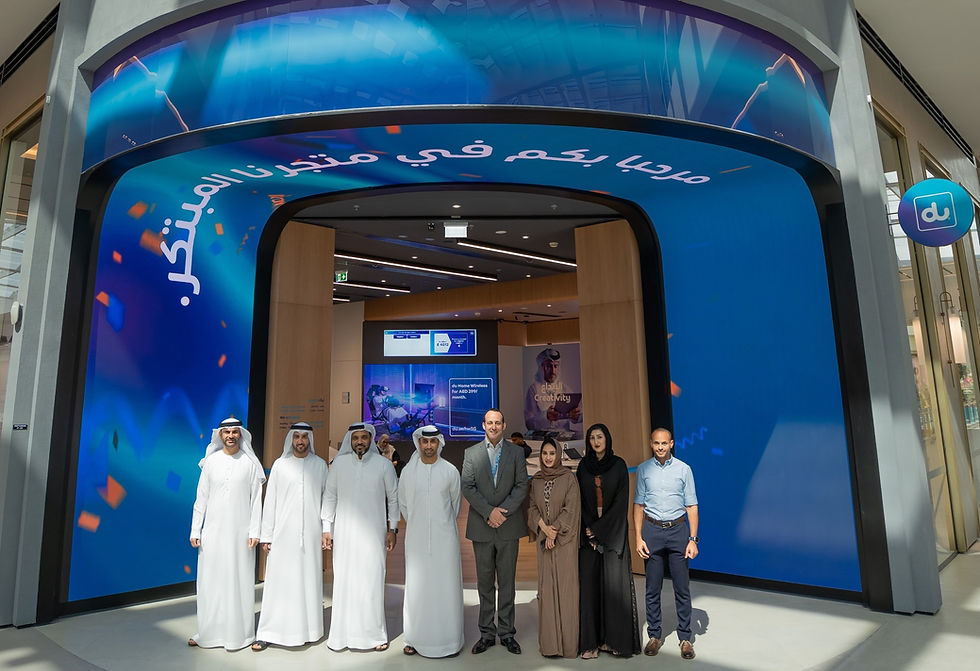
Terrestrial mobile connectivity is progressing from foundation 5G into comprehensive 5G-Advanced architectures. Commercial operator du has expanded testing of ten-gigabit carrier aggregation to deliver ultra-fast speeds to key commercial business zones.
This wireless upgrade brings multi-gigabit throughput to handheld devices and fixed wireless access terminals in residential villas. Network slicing enables autonomous logistics vehicles, remote medical telemetry, and financial trading stations to operate across isolated spectrum lanes without interference from general mobile video streaming.
Peak download speeds ramping from 1 Gbps toward 10 Gbps on commercial millimeter-wave spectrum.
Deterministic sub-5-millisecond network latency designed for mission-critical automation.
Dedicated carrier slicing that isolates enterprise traffic from standard smartphone congestion.
Widespread coverage across Dubai International Financial Centre, Abu Dhabi Global Market, and tech clusters.
Hyperscale Cloud Corridors and Sovereign AI Data Centers

Data pipe expansion directly complements the massive growth of local hyperscale cloud facilities. Regional telecommunications powerhouse e& continues to invest heavily in submarine cable landing terminals along coastal transit corridors.
Sovereign cloud campuses operated by regional artificial intelligence leaders and international platform providers have established direct fiber rings between Abu Dhabi, Dubai, and Sharjah. This domestic routing preserves local data sovereignty while ensuring cloud model training occurs adjacent to international landing points.
Local cloud availability zones mean critical financial computations settle in milliseconds rather than routing through remote European servers.
Practical Impacts for Tech Startups, Freelancers and Remote Teams
For solo founders, software developers, and remote professionals working across Dubai and Abu Dhabi, bandwidth abundance delivers immediate practical advantages. Technology coverage in the Khaleej Times emphasizes how high-capacity digital transit positions local tech enterprises to scale across Middle Eastern markets.
Cloud workspaces that previously suffered from micro-stuttering during intercontinental video conferences now function as if servers were located across the hallway. Startups hosting heavy AI model weights locally can serve global customers with round-trip latencies under eighty milliseconds.
Zero-lag collaborative workflows when rendering 3D digital twins or large-scale media assets.
Significant cost reductions for cloud ingress and egress on locally hosted regional server nodes.
Reliable fallback redundancy preventing single-cable outages from degrading home broadband connections.
Enhanced edge computing capabilities enabling decentralized AI models to run on portable office hardware.
Navigating Legal Compliance and Data Security in the High-Speed Era
Operating on ultra-high-speed connectivity requires keeping regulatory boundaries and security frameworks in sharp focus. Companies operating across mainland and free zone jurisdictions must maintain strict adherence to UAE data governance laws.
Ensuring your cloud architectures, remote virtual private network configurations, and data storage workflows comply with federal oversight shields your enterprise from compliance liabilities while capitalizing on the fastest digital infrastructure network in the region.
UAE Personal Data Protection Law
Federal regulations mandate strict controls over cross-border transfers of sensitive consumer data. Processing data through local sovereign cloud clusters ensures ongoing regulatory alignment.
Authorized Network Practices
Commercial entities utilizing private network tunnels must ensure protocols follow approved telecommunications guidelines. Enterprise compliance avoids penalties while maximizing throughput across corporate branch locations.
Enterprise compliance teams should audit encryption ciphers and transmission protocols annually to align with federal standards.
FAQ
When will consumers see the direct benefits of the 25-fold bandwidth expansion?
While submarine cable capacity scales incrementally through 2030, enterprise and residential users already observe lower ping rates and reduced peak-hour throttling on international video streams and cloud storage backups. 5G-Advanced network towers are actively rolling out across high-density urban areas.
Will the 2030 connectivity roadmap lower home broadband prices in the UAE?
Expanding international bandwidth reduces transit unit costs for national telecom providers, allowing carriers to bundle higher base speeds and larger data quotas into entry-level packages without raising subscription tiers.
How does the UAE protect subsea internet cables from physical damage?
Cables entering UAE landing stations utilize armored marine casing, acoustic seabed monitoring sensors, and designated maritime exclusion zones that prohibit commercial anchorage along cable routes off the Fujairah and Dubai coasts.
What is the primary difference between standard 5G and 5G-Advanced in the UAE?
5G-Advanced introduces multi-carrier aggregation capable of reaching ten gigabits per second download speeds, while cutting packet latency down to single-digit milliseconds. It also supports network slicing to guarantee dedicated bandwidth for industrial Internet of Things systems and autonomous logistics.
Useful Links
UAE Government Portal — official portal detailing federal economic strategy
TDRA — telecom regulator technical framework and standards
Emirates News Agency (WAM) — official news dispatch on connectivity milestones
du — telecommunications operator network upgrade announcements
e& — telecommunications provider subsea and cloud infrastructure
Khaleej Times — regional press coverage of digital infrastructure
Pair It With

— Angel Tyagi, Creator of Angel In Dubai
Prices, timings and availability may change — always check directly with the venue before visiting. Not sponsored.
Story lead: Gulf News. Reporting can be updated or withdrawn after publication — always check the original before relying on anything here.
Rules, fees and deadlines change often. This is a general summary, not legal advice — confirm with the relevant UAE authority before acting.
Photo by BUS TERMINAL IN FUJAIRAH - UAE :: Behance via web, Photo by Cloud Migration Services in Dubai, UAE | AWS, Azure, Oracle & More via web, Photo by unsplash via unsplash


Comments