


UAE Petrol Price Forecast 2026: Cost Guide and Commuting Budgets
Standing on the forecourt of the Al Wasl fuel station as the midday heat softened over Sheikh Zayed Road, I watched the digital display on the pump roll past sixty-five litres. For the past two years, watching those numbers climb was a monthly exercise in financial anticipation, but pulling away with a full tank costing just under AED 170 felt noticeably lighter than the budget crunches we navigated during peak volatility as of October 2026.
With international oil markets absorbing significant new crude supplies and regional export pipelines running at high efficiency, the conversation around commuting costs in Dubai is shifting. As someone who logs hundreds of kilometers weekly across the emirates tracking household expenses, understanding where petrol prices are heading in 2026 is critical for anyone managing transportation budgets. All figures are indicative — verify with the fuel retailer / Fuel Price Committee, and this is not financial advice.
At a glance | Details |
|---|---|
Special 95 Price | AED 2.54 per litre as of 1 October 2026 |
Super 98 Price | AED 2.66 per litre as of 1 October 2026 |
2026 Crude Forecast | USD 65 to 78 per barrel as of October 2026 |
Average Monthly Commute | AED 350 to 510 across Dubai routes as of October 2026 |
Price Committee Schedule | Announced monthly on the final calendar day |
Current UAE Petrol Prices and How Deregulation Works

Official announcements from the Ministry of Energy and Infrastructure set domestic pump rates on the final day of each calendar month as of October 2026. The Fuel Price Committee reviews global crude movements over the preceding twenty-eight days to establish uniform retail tariffs across all emirates. Retail forecourts operated across the country by ADNOC Distribution reflected Super 98 at AED 2.66 per litre as of 1 October 2026. For drivers filling a standard 60-litre family crossover, a complete refill currently tallies approximately AED 152.40 for Special 95 as of October 2026. All figures are source-verified against official ministry releases as of October 2026 and are indicative — verify with the fuel retailer / Fuel Price Committee.
Under policy frameworks published on the UAE Government Portal, local pump prices track global benchmark averages rather than receiving state subsidies. This deregulation policy began in August 2015, replacing legacy subsidized pricing with an open market mechanism designed to incentivize fuel conservation and promote public transport adoption. The pricing formula incorporates international Mean of Platts Arab Gulf (MOPAG) refined product prices, maritime transport logistics, local storage expenses, and a fixed retailer margin of approximately AED 0.25 per litre as of October 2026. This structure ensures that local fuel retailers operate on sustainable commercial models while motorists capture savings whenever international oil benchmarks decline.
Urban motorists refuelling at local ENOC stations in Dubai paid AED 2.54 per litre for Special 95 as of 1 October 2026. Pricing updates at neighborhood pumps from Emarat confirmed commercial diesel settled at AED 2.60 per litre as of 1 October 2026. Because prices remain completely uniform across Dubai, Abu Dhabi, and the Northern Emirates, drivers do not need to hunt across brands for cheaper fuel. The primary variance in spending comes down to driving habits, route choices, and broader macroeconomic shifts that dictate monthly rate revisions. Source: UAE Fuel Price Committee as of 1 October 2026. All rates are indicative — verify with the fuel retailer / Fuel Price Committee. This is not financial advice.
Fuel Grade | Oct 2026 | 2026 Range |
|---|---|---|
Super 98 | AED 2.66 | AED 2.55-2.90 |
Special 95 | AED 2.54 | AED 2.42-2.78 |
E-Plus 91 | AED 2.47 | AED 2.35-2.70 |
Diesel | AED 2.60 | AED 2.48-2.85 |
Tracking the monthly committee announcement on the 30th has saved me at least AED 150 every time a price drop looms.
Global Crude Supply Surges and Benchmark Projections for 2026
Global crude oil fundamentals serve as the primary locomotive steering monthly petrol price revisions in the UAE. Understanding international inventory balances and export volumes provides valuable visibility into whether your monthly refuelling bill will expand or contract over coming quarters. Source data from the International Energy Agency confirms global oil inventories grew by an average of 450,000 barrels per day during mid-2026 as of October 2026. All projections are indicative — verify with the fuel retailer / Fuel Price Committee. This is not financial advice.
Expanding Non-OPEC Production and Atlantic Basin Flows
International petroleum markets entered late 2026 under substantial downward price pressure generated by non-OPEC production growth. Major upstream producers in the United States, Brazil, and Guyana added over 1.8 million barrels per day of fresh supply to global balance sheets through the third quarter as of October 2026. S&P Global Commodity Insights projects global crude demand growth to moderate to 1.1 million barrels per day as of October 2026, leaving markets in a structural supply surplus. With Brent crude trading between USD 71 and USD 75 per barrel as of October 2026, energy analysts forecast trading ranges between USD 65 and USD 78 per barrel through mid-2027 as of October 2026. All projections are indicative — verify with the fuel retailer / Fuel Price Committee.
Regional Export Dynamics and Tanker Logistics
Simultaneously, Middle Eastern crude producers and regional refiners have optimized logistical routes and expanded crude handling capacities at export hubs like Fujairah and Ruwais. The addition of new processing units across the Arabian Gulf has expanded domestic availability of ultra-low sulfur diesel and high-octane gasoline blending components as of October 2026. Reduced freight premiums on regional routes have helped compress landed product costs at domestic distribution hubs. For UAE motorists, these international trade flows mean raw feedstock costs passed down to domestic fuel retailers are projected to remain stable or soften further throughout 2026 as of October 2026. All estimates are indicative — verify with the fuel retailer / Fuel Price Committee.
The Fuel Price Committee Formula and Refining Margins
Many Dubai residents wonder why local petrol prices do not drop in exact lockstep whenever crude oil drops on financial news channels. The UAE Fuel Price Committee evaluates refined product benchmarks rather than raw unrefined crude oil. The price differential between a barrel of unrefined crude and the refined gasoline produced from it, known in the energy industry as the crack spread, fluctuates based on seasonal refinery maintenance schedules, regional demand spikes, and global environmental mandates. As of October 2026, Singapore and Arab Gulf gasoline crack spreads averaged approximately USD 7.80 per barrel according to Platts benchmark assessments. All figures are indicative — verify with the fuel retailer / Fuel Price Committee.
In addition to refining margins, the domestic pricing formula accounts for federal and local transportation tariffs, marine insurance, terminal storage overhead, and the commercial operating margin for retail fuel distributors. The 5 percent Value Added Tax (VAT) introduced in 2018 also applies to all domestic fuel sales at the pump. When factoring in these fixed infrastructure and distribution layers, crude feedstock represents roughly 55 to 60 percent of the final price at the nozzle as of October 2026. This baseline buffering prevents wild overnight swings while providing transparent, market-aligned price discovery for consumers. Source: UAE Ministry of Energy and Infrastructure as of October 2026. This is not financial advice.
Seeing how international shipping rates and crack spreads feed into our local prices helped me realize why pump rates do not mirror Brent crude dollar-for-dollar.
Commuting Budget Breakdown Across Popular UAE Driving Routes
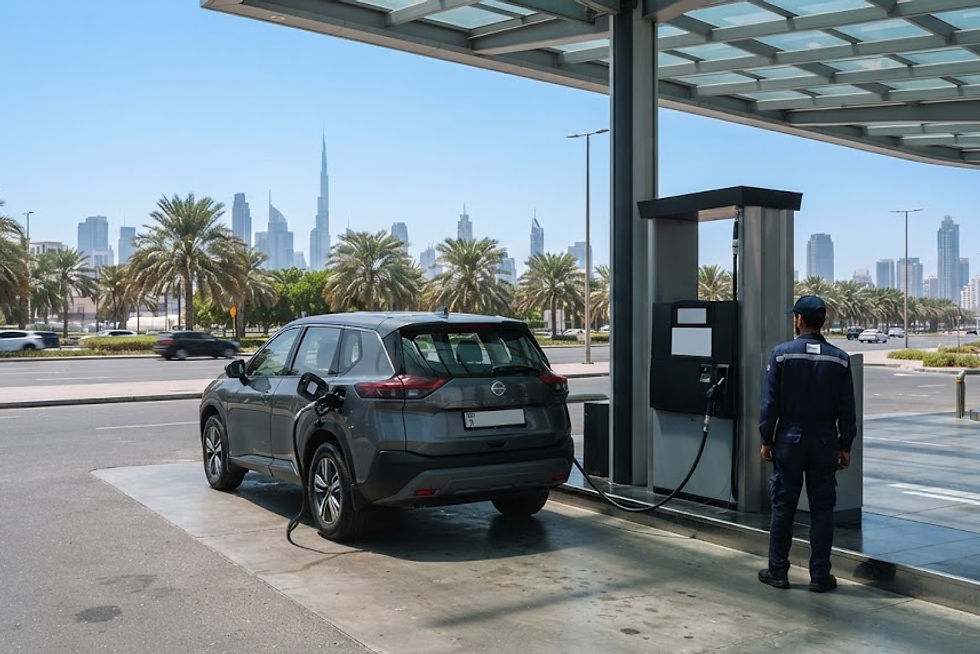
Commuting expenses form a core component of everyday living costs for professionals working across Dubai, Abu Dhabi, and Sharjah. Quarterly economic reviews from the Central Bank of the UAE show transportation expenses represent approximately 12 percent of average household expenditure baskets as of October 2026. To translate per-litre price movements into actual bank balance impacts, I analyzed typical daily roundtrips for popular vehicle classes averaging 8.5 litres per 100 kilometers on Special 95 at AED 2.54 per litre as of 1 October 2026. All route estimates assume 22 working days per calendar month and are indicative — verify with the fuel retailer / Fuel Price Committee.
A resident commuting daily from Mirdif or Downtown Dubai to Dubai Marina covers roughly 50 kilometers roundtrip along Sheikh Zayed Road or Al Khail Road, resulting in a monthly petrol outlay of AED 320 to AED 380 as of October 2026. For cross-emirate professionals driving from Al Nahda or Al Mamzar in Sharjah into DIFC, stop-and-go congestion raises fuel consumption, pushing monthly petrol costs to AED 420 to AED 510 as of October 2026. Long-distance commuters commuting between Dubai and the capital Abu Dhabi log 280 kilometers roundtrip daily, racking up AED 1790 to AED 2100 per month on fuel alone as of October 2026 before accounting for vehicle maintenance or Salik toll fees. Source: RTA Dubai traffic benchmarks as of October 2026. This analysis is for consumer planning purposes only and this is not financial advice.
Daily Route | Roundtrip | Monthly Fuel |
|---|---|---|
Downtown to Marina | 50 km | AED 320-380 |
Sharjah to DIFC | 65 km | AED 420-510 |
Dubai to Abu Dhabi | 280 km | AED 1790-2100 |
Mirdif to Media City | 70 km | AED 450-540 |
Calculating fuel cost per kilometer rather than full tank fill-ups changed the way I budget my weekly Sharjah commute.
Practical Ways to Lower Monthly Commuting Expenses in Dubai
While motorists cannot control global oil benchmarks or the Fuel Price Committee monthly announcements, optimizing driving patterns and payment methods delivers immediate cash savings. Commuters comparing driving costs with public transit options from RTA Dubai note monthly metro passes cost AED 350 for all zones as of October 2026. For many drivers, blending private vehicle journeys with mass transit or simply refining everyday driving habits can trim AED 150 to AED 300 from monthly transportation expenses as of October 2026. All rate figures and savings metrics are source-verified as of October 2026 and are indicative — verify with the fuel retailer / Fuel Price Committee.
Choosing payment methods tailored to automotive spending is another straightforward optimization. Several UAE retail banks offer dedicated fuel cashback programs returning 5 to 10 percent on service station transactions, subject to minimum monthly card spends as of October 2026. Pairing these financial products with steady driving speeds between 100 and 110 km/h on highways like Sheikh Mohammed Bin Zayed Road maximizes aerodynamics and engine efficiency as of October 2026. Every kilometer of smooth cruising directly mitigates the impact of minor fuel price upticks. This is not financial advice.
Combine weekly errands into single linked trips to avoid cold engine starts that consume up to 20 percent more fuel during the first five minutes of driving as of October 2026.
Maintain manufacturer-recommended tire pressures checked monthly at service station air gauges to avoid a 3 percent drag penalty on fuel economy as of October 2026.
Utilize specialized UAE credit cards offering up to 10 percent cashback on fuel spend at ENOC, ADNOC, and Emarat stations up to monthly category caps as of October 2026.
Leverage off-peak travel windows to avoid heavy peak-hour bottleneck idling along the E11 and E44 corridors as of October 2026.
Consider park-and-ride facilities at Centrepoint or Stadium metro stations for direct access into central commercial zones as of October 2026.
Long-Term Outlook and Fleet Transition Trends for 2026
Looking ahead through the remainder of 2026 and into 2027, the relationship between personal transport budgets and crude oil prices will continue to evolve alongside automotive technology. While petrol prices are expected to remain within comfortable historical ranges between AED 2.40 and AED 2.90 per litre for Special 95 as of October 2026, vehicle fleet electrification provides an increasing ceiling on household fuel vulnerability. Analyzing your vehicle replacement cycle against your monthly mileage ensures you stay ahead of transport inflation regardless of geopolitical tides. All figures are indicative — verify with the fuel retailer / Fuel Price Committee. This is not financial advice.
Electric Vehicle Charging Tariffs and Home Wallboxes
As the UAE advances toward its Net Zero 2050 strategic goals, electric vehicle adoption is actively reshaping personal commuting calculations across Dubai. Dubai Electricity and Water Authority (DEWA) public EV Green Charger stations apply commercial charging tariffs of 38 fils per kilowatt-hour plus VAT as of October 2026. For an electric crossover equipped with a 75 kWh battery pack, a full recharge at a public station costs roughly AED 30.00 for a realistic driving range of 420 kilometers as of October 2026. When charged overnight at residential villa tariffs of 23 to 28 fils per kWh, that cost drops to approximately AED 21.00 as of October 2026. All utility tariffs are indicative — verify with the fuel retailer / Fuel Price Committee or local utility authorities.
Hybrid Powertrains for High-Mileage Motorists
For motorists living in rental apartments without dedicated overnight charging infrastructure, hybrid sedans and compact SUVs remain the most practical hedge against fuel price fluctuations. Modern self-charging hybrids routinely achieve fuel efficiency figures of 4.0 to 4.5 litres per 100 kilometers in urban traffic as of October 2026, effectively halving monthly petrol expenditure compared to equivalent conventional petrol engines. At current Special 95 rates of AED 2.54 per litre as of 1 October 2026, a 50-kilometer daily commute in a hybrid costs less than AED 175 per month in fuel as of October 2026. Source calculations reflect official manufacturer fuel consumption ratings and current committee tariffs. This is not financial advice.
FAQ
When are UAE petrol prices announced each month?
The UAE Fuel Price Committee meets during the final week of every calendar month and announces updated prices on the last day, typically between the 28th and 31st. The revised retail tariffs take effect at midnight on the first day of the following month across all service stations nationwide. Motorists can monitor the Ministry of Energy and Infrastructure portal for the official announcement as of October 2026.
Why do UAE petrol prices change every month?
Fuel prices in the UAE have been deregulated since August 2015 to align domestic consumption with international market realities and support fiscal sustainability. Instead of fixed state subsidies, monthly retail rates are tied to global crude oil benchmarks, international shipping expenses, refining margins, and retail operating overheads. When international benchmark prices decline, domestic consumers directly benefit at the pump as of October 2026.
Is Special 95 or Super 98 better for driving in Dubai?
Special 95 satisfies the octane requirements for over 90 percent of standard passenger sedans, hatchbacks, and crossover SUVs driven in the UAE. Super 98 is engineered specifically for high-compression engines, sports cars, and luxury performance vehicles requiring higher resistance to engine knocking. Using Super 98 in an engine designed for 95 does not improve mileage or power output, but adds roughly AED 0.12 per litre to your fuel bill as of October 2026.
Does petrol cost the same across all petrol stations in the UAE?
Yes, retail fuel prices are standardized across all seven emirates by federal mandate. Whether you pull into an ADNOC Distribution station in Abu Dhabi, an ENOC or EPPCO pump in Dubai, or an Emarat forecourt in Sharjah, the price per litre for Super 98, Special 95, E-Plus 91, and Diesel is identical on any given day of the month as of October 2026.
Useful Links
Ministry of Energy and Infrastructure — official monthly fuel price announcements
ADNOC Distribution — service station retail fuel rates
UAE Government Portal — fuel deregulation policy guidelines
ENOC — Dubai service station network stations
Emarat — Dubai and Northern Emirates fuel prices
Central Bank of the UAE — inflation reports and economic projections
RTA Dubai — metro and bus route fare tables
Pair It With

— Angel Tyagi, Creator of Angel In Dubai
Prices, timings and availability may change — always check directly with the venue before visiting. Not sponsored.
Story lead: khaleejtimes.com. Reporting can be updated or withdrawn after publication — always check the original before relying on anything here.
Rates and figures are indicative and were correct as of 6 October 2026; they change often, so verify with the provider before acting. This is general information, not financial advice.
Rules, fees and deadlines change often. This is a general summary, not legal advice — confirm with the relevant UAE authority before acting.
Photo by ENOC Group opens a new service station to meet fuelling needs in Dubai ... via web, Photo by Orient Series Digital Fuel Dispensers Petrol Pump Machine Fuel ... via web, Photo by AI-generated illustration via gemini


Comments