


Dubai 2.1 Trillion Dirhams Infrastructure Projects List: 2026 Guide
Standing beside the scaled masterplan display at the Dubai World Trade Centre exhibition floor this October 2026, the sheer capital momentum across the emirate is impossible to miss. Vivid digital overlays trace the 30-kilometre route of the Dubai Metro Blue Line, while expansive zoning blueprints mark the industrial and residential corridors fanning outward from Dubai South.
Dubai leadership has confirmed an active infrastructure pipeline exceeding Dh2.1 trillion across transport networks, aviation capacity, municipal drainage, and power generation as of October 2026. For commercial allocators and property owners, tracking these state-backed capital allocations provides essential visibility on where long-term demographic growth and regional connectivity are heading.
At a glance | Details |
|---|---|
Total Pipeline | AED 2.1 trillion across active projects |
Aviation Hub | AED 128B Al Maktoum Airport expansion |
Rail Transit | AED 18B Dubai Metro Blue Line |
Rainwater Network | AED 30B Tasreef drainage project |
Core Strategy | Dubai Economic Agenda D33 targets |
Scope of the Dh2.1 Trillion Strategic Pipeline

The scale of public capital expenditure across the emirate reflects the targets set under the Dubai Economic Agenda D33, which aims to double the size of Dubai's economy by 2033. According to verified project monitoring updates published on the UAE Government Portal as of October 2026, the Dh2.1 trillion figure encompasses both fully funded municipal initiatives and public-private partnership contracts spanning urban mobility, aviation logistics, grid resilience, and water infrastructure.
Rather than concentrating spending exclusively within high-density prime tourism districts, current outlays prioritize regional connectivity and heavy transport arteries. Over 60 percent of active capital allocations focus on orbital road networks, mass rapid transit, and municipal utilities designed to support an anticipated permanent resident population of 5.8 million by 2040. Note that all project valuations and schedule projections are indicative — verify with the bank/developer or relevant municipal body before allocating capital. This analysis is prepared solely for informational purposes, and this is not financial advice.
Capital Allocation by Key Sectors
Transportation and logistics command the single largest share of the pipeline at approximately 45 percent, driven by massive transit and airport expansions. Utilities, clean energy, and municipal water management account for roughly 30 percent, while urban regeneration and civic social infrastructure absorb the remaining 25 percent as of October 2026 based on municipal budget releases.
Funding Mechanisms and Private Participation
Financing structures have diversified beyond traditional sovereign allocations. Dubai relies increasingly on public-private partnership models, green bond issuances, and concession contracts overseen by the Department of Finance, creating structured procurement opportunities for international contractors and institutional lenders.
Flagship Transit and Highway Mega-Projects
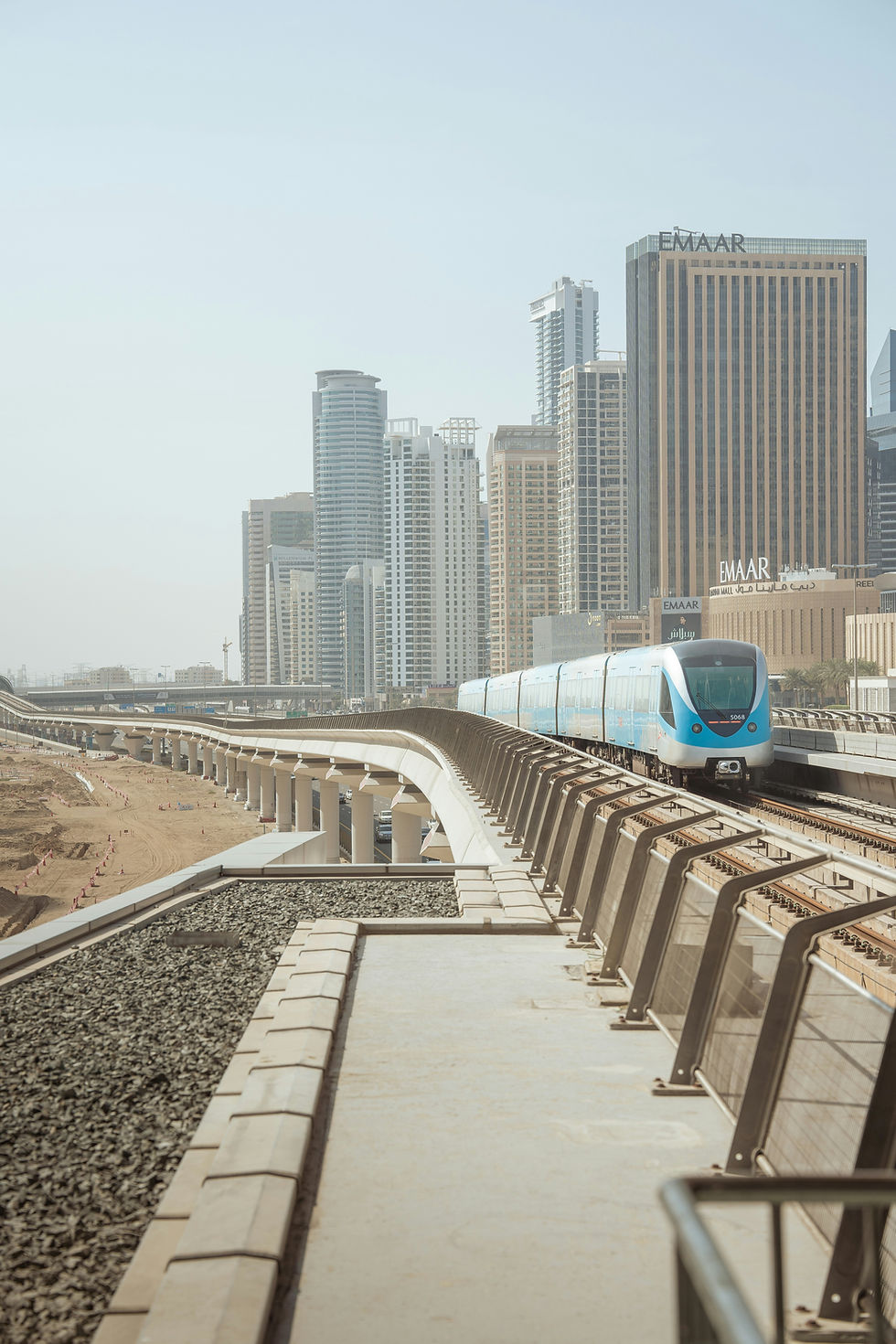
Urban mobility remains the linchpin of Dubai's urban infrastructure plan. Central to this strategy is the AED 18 billion Dubai Metro Blue Line project managed by RTA Dubai, which will add 30 kilometres of track and 14 stations connecting established commercial hubs with rapidly growing residential clusters. Official design contracts confirmed by RTA Dubai as of October 2026 indicate that the line will serve key population centres including Dubai Creek Harbour, Ras Al Khor, Dubai Silicon Oasis, and Dubai Academic City.
Road network enhancements are progressing in parallel. Major orbital arteries including Sheikh Mohammed Bin Zayed Road (E311) and Emirates Road (E611) are undergoing phased junction expansions and smart traffic management upgrades to decongest primary logistics corridors linking Jebel Ali Port to northern distribution hubs.
Project | Capital | Timeline |
|---|---|---|
Metro Blue Line | AED 18 billion | Operational by 2029 |
Al Maktoum Airport | AED 128 billion | Phase 1 by 2032 |
Tasreef Drainage | AED 30 billion | Completion by 2028 |
Transit proximity consistently drives tenancy demand across Dubai, making the Blue Line station map the most critical blueprint for rental yield analysis.
Aviation Expansion and Logistics at Dubai South
The cornerstone of Dubai's long-term commercial logistics strategy is the multi-phase redevelopment of Al Maktoum International Airport at Dubai South. Official masterplan updates released by Dubai Airports as of October 2026 confirm an initial expansion phase budgeted at AED 128 billion. The masterplan envisions an eventual capacity of 260 million passengers and 12 million tonnes of cargo annually across five parallel runways.
The spillover impact on surrounding industrial clusters is already reshaping industrial land values and warehouse absorption rates. Free zone districts within Dubai South have recorded sustained commercial lease activity, as multinational logistics providers position fulfillment facilities adjacent to the planned multimodal sea-to-air transport corridor.
Five parallel runways designed for simultaneous independent operations
Over 400 aircraft contact gates supporting wide-body fleet consolidation
Dedicated multimodal logistics corridor connecting directly to Jebel Ali Port
Integrated passenger rail terminals linking into the national Etihad Rail network
Drainage, Utilities, and Clean Energy Networks
Climate resilience and resource security have received dedicated capital commitments following regional weather events. Municipal authorities led by Dubai Municipality have commenced procurement on the AED 30 billion Tasreef strategic stormwater tunnel network as of October 2026. This comprehensive subterranean drainage system will handle over 20 million cubic metres of rainwater daily across all urban catchments, safeguarding commercial real estate and highway corridors.
In the utilities sector, power generation and potable water expansion continue under the stewardship of Dubai Electricity and Water Authority. The multi-phase Mohammed bin Rashid Al Maktoum Solar Park represents an aggregate planned investment of AED 50 billion, expanding clean power production toward Dubai's goal of 100 percent clean energy capacity by 2050. Desalination infrastructure is simultaneously transitioning to energy-efficient reverse osmosis technology at the Jebel Ali Power Complex.
Tasreef Deep Tunnel Engineering
The Tasreef initiative utilizes deep-tunnel gravity drainage designed to collect surface runoff across a massive catchment area encompassing Dubai South, Jebel Ali, and central urban districts. Dubai Municipality reports that the project is structured for phased commissioning through 2028, ensuring minimal disruption to surface road corridors during construction.
Grid Modernization and Storage Systems
Dubai Electricity and Water Authority has deployed grid-scale battery energy storage systems alongside expanding solar photovoltaic output. Smart grid substations ensure stable distribution across newly zoned industrial hubs, supporting both heavy manufacturing and hyper-scale data centre facilities.
Real Estate Corridors and Investment Implications
Infrastructure expansion serves as the leading indicator for medium-term capital appreciation and rental yield dynamics across Dubai's property sectors. Historical transaction records maintained by Dubai Land Department demonstrate that communities within a 15-minute walking radius of newly operational mass transit stations trade at an average rental premium of 12 to 18 percent compared to car-dependent suburban developments as of October 2026.
Residential absorption has accelerated along the planned Blue Line route, notably within Dubai Silicon Oasis, International City, and Dubai Creek Harbour. In the commercial sphere, logistics warehouses in Dubai South and Dubai Industrial City have seen prime yields stabilize between 7.5 and 8.5 percent. However, yield figures are purely indicative — verify with the bank/developer or qualified asset appraiser prior to executing any purchase contract. Never rely on promised returns, as macro market shifts and delivery timelines directly affect capital performance.
Allocating capital ahead of completed infrastructure requires matching your holding period to municipal construction milestones rather than developer marketing timelines.
Investor Due Diligence and Execution Framework
Navigating opportunities linked to sovereign infrastructure requires disciplined verification rather than speculative positioning. Private investors, fund managers, and corporate treasurers should evaluate project delivery schedules against verified regulatory benchmarks to mitigate execution risk. Regulatory guidelines published by the Central Bank of the UAE establish clear risk-management standards for commercial real estate exposure and cross-border project financing as of October 2026.
Following an orderly due diligence sequence helps investors avoid premature capital commitments in corridors where utility energization or transit delivery remains multiple years away.
Verify official masterplan zoning and transit station plots using the Dubai Land Department planning portal
Confirm utility connection approvals and DEWA grid capacity quotas for specific commercial plots
Inspect contractor track records and sovereign escrow compliance before signing off-plan property commitments
Stress-test cash flow forecasts against potential construction milestone delays of 12 to 24 months
FAQ
What constitutes the Dh2.1 trillion Dubai infrastructure pipeline?
The Dh2.1 trillion pipeline encompasses public-private partnerships, sovereign transport networks, clean energy power stations, and municipal stormwater tunnels underway across Dubai through 2033. It aggregates active budgets from agencies including RTA, DEWA, Dubai South, and Dubai Municipality.
When is the Dubai Metro Blue Line scheduled to begin operations?
The 30-kilometre Dubai Metro Blue Line is scheduled to start initial passenger operations by 2029 following civil construction and systems testing. The route will feature 14 stations linking five key urban planning regions including Dubai Creek Harbour and Academic City.
How does the Al Maktoum Airport expansion impact surrounding property values?
Aviation hub expansions typically bolster commercial land values and industrial logistics warehousing within Dubai South, followed by residential demand from airline staff and logistics personnel. However, noise abatement corridors and long phased delivery timelines mean capital appreciation varies significantly across specific sub-districts.
What is the completion timeline for the AED 30 billion Tasreef rainwater project?
The Tasreef strategic stormwater tunnel network is slated for phased delivery with final system commissioning targeted for 2028. It provides deep-tunnel gravity drainage capable of moving over 20 million cubic metres of rainwater daily to safeguard urban highways and residential developments.
Useful Links
UAE Government Portal — access federal project data and policies
RTA Dubai — track transit projects and route maps
Dubai Airports — review passenger and cargo master plans
Dubai Municipality — check municipal drainage and zoning regulations
Dubai Electricity and Water Authority — inspect clean energy and grid projects
Dubai Land Department — verify property transactions and rental yields
Central Bank of the UAE — review commercial mortgage and lending guidelines
Pair It With

— Angel Tyagi, Creator of Angel In Dubai
Prices, timings and availability may change — always check directly with the venue before visiting. Not sponsored.
Story lead: The National. Reporting can be updated or withdrawn after publication — always check the original before relying on anything here.
Rates and figures are indicative and were correct as of 15 October 2026; they change often, so verify with the provider before acting. This is general information, not financial advice.
Photo by Martijn Vonk via unsplash, Photo by Wallpaper Dubai, Burj Khalifa, Landmark, Fountain, City, Background ... via web


Comments